Horror has been a staple genre in films for many years, going all the way back to the silent era of films. It is arguably the most popular genre of film of all time, spanning different time periods and even cultures. Despite inducing fear and terror and maybe even trauma, people continue to be to entertained by this frightful genre. While classic horror films typically feature undead, supernatural beings such as as the main villain, sometimes monsters, humans and even aliens can become the antagonist. Even
tyres can be something to be afraid of. But, no matter what time period, culture, or antagonist, horror films have one goal: to make the viewer feel scared. While we might think that horror films at the time aren't as terrifying as they are now, they surely were to the people who first watched them.
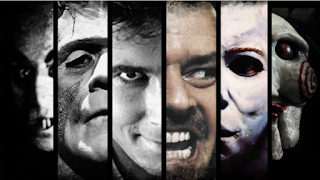 |
Horror films typically feature a villain with malicious
intent bent on killing the protagonists.
Image courtesy of nofilmschool.com |
Nowadays, horror films are typically divided into 3 main sub-genres: psychological, slasher, and gothic. Psychological horror films usually have the most supernatural elements to them, as they want to have a 'psychological' impact on the viewer, using emotions such as fear, guilt, and paranoia and effects such as sounds, lighting, mise-en-scene, and character designs to keep them scared even after the film is over. One popular example of a psychological horror is
The Ring (2002). Slasher films, on the other hand, focus more on a psychopathic killer who goes on murdering people in violent ways, and therefore contain aspects of gore. They aren't as mentally scarring as psychological horror films, but can still be quite disturbing. Examples include
Friday the 13th (1980),
Halloween (1978), and
A Nightmare on Elm Street (1984). Finally, we have gothic horror films. They combine elements of death, horror, and often romance. The typical conventions of a gothic horror include a gloomy setting, supernatural beings, curses, prophecies, damsels in distress, etc. The most well known gothic horror films were made by Universal Studios in the 1920s to the 1950s, with the collection of these films usually referred to as "Universal Horror".
One particularly famous example of a gothic horror film is
Nosferatu, eine Symphonie des Grauens (1922), also known as
Nosferatu: A Symphony of Horror, or simply
Nosferatu. It is an unauthorised adaption of Bram Stoker's novel
Dracula, directed by Friedrich Wilhelm Murnau, and produced by Prana Studio. The film stars Max Schreck as Count Orlok, the main vampire in the film. To avoid copyright infringements, Murnau made several changes to the characters' names, settings, and even the story to some extent. Ultimately, the studio was forced to file for bankcruptcy because they were sued and all copies of the film were ordered to be destroyed. Fortunately however, some copies have survived to this day and were restored, and the film itself is considered to be a classic.
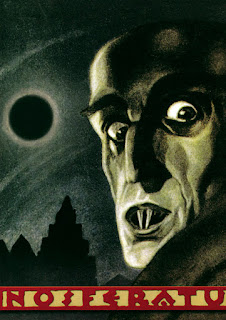 |
| An original 1922 poster of Nosferatu, taken from traileraddicts.com |
Nosferatu is known for being a German Expressionist film, where conventions that started outside of Germany are rejected, and the reality within the movie is shown to be heavily distorted, with wild aesthetics. The movement started due to Germany's rejection of foreign films. The film is also known for using real locations rather than exaggerated sets. The film also uses iris lenses for shooting dark scenes, as cameras at the time did not work well in the dark. Therefore, the film shot night scenes in the day, while trying to make it look like it was night. Being a silent film,
Nosferatu uses intertitles to show dialogue as well as narration. The effect of the intertitle may vary from person to person, but it may add suspense to the film as it can create short pauses during tense scenes, but they may also reduce suspense since they take the viewer out of the film for a second. The intertitles in
Nosferatu tend to be short and only contain a few words, unless it is a narration, where it becomes very descriptive.
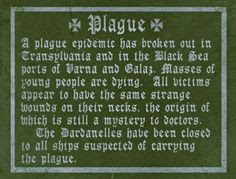 |
| A very descriptive intertitle that appears in the film |
The word "Nosferatu" is, in fact, made up for the film. While it is presented as a Romanian word synonymous with "vampire", there is no such word in the Romanian language. However, some theories suggest that the word does indeed have some Romanian origin to it. Some people suggest that the word may have been derived from or misinterpreted from the Romanian words "nesuferitu" and "necurat", meaning "the unclean" and "the insufferable" respectively. Because vampires are considered to be "unholy spirits", these possibilities make sense. The word may also stem from the Greek "Nosophoros", meaning bringer of plague, as in the film Count Orlok spreads the plague with him everywhere he goes.
Because of how early in film history it was produced in,
Nosferatu is considered to be an archetype of the vampire genre and even the horror genre as a whole. It defined various aspects of vampires that later films would follow, and we can see various conventions that are present in this film commonly found in modern horror films. One of the most iconic scenes in
Nosferatu being the scene where Count Orlok climbs the stairs to Ellen's room and his shadow is cast on to the wall.
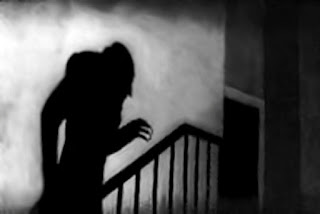 |
| The scene towards the end of the film as Orlok approaches Ellen. |
This technique has been used time and time again to show the villain approaching one of the protagonists, usually in a helpless state. This technique is also done at the beginning of the film where the Count approaches Hutter in his room.
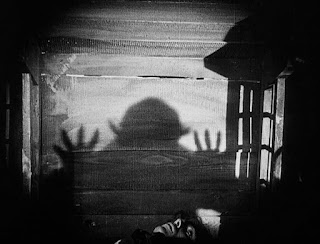 |
| Orlok's shadow cast on the wall while Hutter hides helplessly at the bottom of the frame. |
The above shot also happens to be a subjective shot, since we are seeing it from Orlok's point of view. It creates a sense of dread and terror as he approaches Hutter.
We can assume that
Nosferatu is a gothic horror film, as it does have elements of goth, curses, prophecies and even a damsel in distress. It can't be a slasher since the Count does not go on a violent killing spree, and it also can't be a psychological horror since it doesn't leave a psychological impact on the viewer (at least in modern times). Therefore,
Nosferatu is a gothic horror.
It is easy to spot some common tropes and conventions of modern horror films in this film. For example,
Nosferatu may have popularised the idea that sunlight is deadly to vampires, and doesn't just weaken them like in Bram Stoker's
Dracula. Another trope of the gothic horror genre that appears in the film is the "henchman" archetype, in the form of Knock. We can see that in contrast to the Count, Knock looks much less threatening, and does not seem to have supernatural powers of his own. Also, at one point of the film the setting becomes that of the Count's castle in Transylvania, with castles being a popular setting in the goth culture. The music is also orchestral, typical of the gothic culture. When Hutter first meets Orlok, he does not realise he is a vampire until he starts sucking his blood, a common trope where the protagonist does not realise the presence of 'the bad guy' even though its somewhat obvious. The film also gives the Count ghost-like abilities, such as revealing himself to a sailor on the ship and then dissapearing again, and in a later scene he physically passes through the door to his new house in Wisborg. Finally, there is the trope where the castle gates open by themselves, as well as the other iconic scene where the Count raises himself from the coffin on the ship.
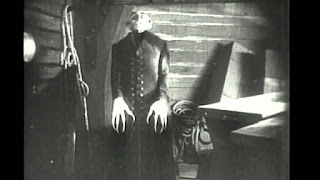 |
| The iconic scene where Count Orlok raises himself from a coffin. |
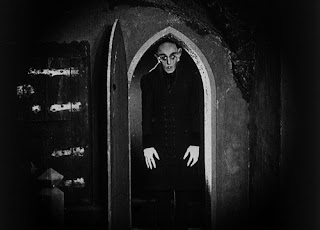 |
Another memorable scene from the film,
most known for its appearance in Spongebob Sqaurepants. |
However, some conventions in
Nosferatu never really caught on with modern vampire or horror films. For example, Count Orlok is portrayed as being hideous and having a skeletal figure with long fingernails and a bald head. In modern times however, vampires are portrayed as suave, cunning, handsome, and overall attractive. Additionally, vampires today are shown to be able to turn others into vampires, while in
Nosferatu Orlok simply kills people after he sucks their blood. The Count is also able to spread disease in this film, while modern vampires don't. Also, in
Nosferatu it is shown that Count Orlok has some association with rats, while modern vampires are usually associated with bats, and may even be able to transform into them.
The film also uses chiaroscuro lighting heavily, where lights and shadow are starkly contrasted. Despite being used in many scenes, only some scenes have succesfully used it to create a unique effect, particularly the scenes where Ellen gets attacked by Orlok.
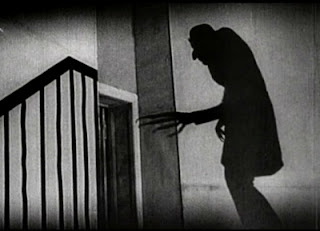 |
| Orlok entering Ellen's room |
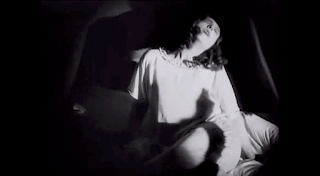 |
| Ellen after being bitten by Orlok |
In both scenes, there is a clear contrast between the blacks and the whites. This accentuates a feeling of dread and mystery within the scene. It may also create a feeling where the darkness takes over the light, or that evil has triumphed over justice. This form of lighting also contrasts the scene right after, where Orlok gets killed by sunlight.
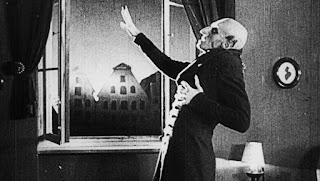 |
While the previous scenes have stark contrast between whites and blacks,
here the contrast is much more subtle. |
F. W. Murnau was an apparent homosexual, and this was exaggerated in the metafictional adaptation of
Nosferatu's production,
Shadow of the Vampire.While not shown directly in the film, some aspects may allude to his repressed homosexuality. For example, Orlok's lust for Ellen may have represented Murnau's feeling of frustration and restraint. In the film, Orlok lives in a castle isolated from civilisation. Orlok's isolation may also represent Murnau's feeling of loneliness. It is also interesting to note how Orlok interacts with Hutter. When Hutter first arrives at Orlok's castle and cuts himself during dinner, Orlok suddenly and forcefully tries to suck his blood. In fact, during the whole dinner scene Orlok is shown to simply be watching Hutter as he eats, while seemingly reading papers. Finally, while Orlok usually kills his victims including the ship captain ultimately Ellen, Orlok leaves Hutter alive. This may be hinting that Murnau is inserting part of his personality into Orlok. Orlok is also shown to have interest in Ellen, but when he actually meets her, Orlok only wants her blood and kills her. This could show how Murnau has desires to be with people, but in different ways than most would expect.
Nosferatu is considered to be a legendary film for its time, inventing some conventions that horror films would follow today. While it may not seem as terrifying compared to modern horror films, it does set a great example of a classic vampire film, and is still entertaining even today.
Sources
www.slideshare.net/lalaland_xo/horror-film-forms-and-conventions
http://study.com/academy/lesson/gothic-novels-characteristics-examples.html
http://eric.b.olsen.tripod.com/nosferatu.html
http://www.liquisearch.com/nosferatu_word/origins_of_the_name
https://news.artnet.com/market/art-house-an-introduction-to-german-expressionist-films-32845
http://tvtropes.org/pmwiki/pmwiki.php/Film/Nosferatu
https://www.academia.edu/5328269/Murnau_and_the_Evil_of_Sexuality_A_Look_at_Nosferatu_and_Sunrise
https://pinoy-comics-tv-movies.blogspot.sg/2010/01/filipino-boy-and-death-of-murnau.html